Tuesday, October 26, 2010

Problem solving - when really stuck try...

  • A cup of tea/coffee
  • Social chat with a colleague
  • Walk in the *fresh air
  • Visit a huge building with great architecture/decor
Most of those points are really obvious, but all too easy to forget, when engrossed in a tough Mathematical problem.

*Without realising it you might be really need the fresh air!
( If you work in a Science building and have your own small office, then sitting in there all day with the door closed, will reduce the air quality. )

Visiting the Science Museum in London, a local historic building, or a local Cathedral usually works for me also.
( The Cathedral is not my way of seeking 'something divine', but they are usually architecturally interesting and generally not full of hustle and bustle )

For some, a Distraction can also work, and there is a Psychological Science Article summary here giving some details.

The full 2008 research paper by Chen-Bo Zhong, Dijksterhuis, and Galinsky can be found at utoronto.ca here.

Another option, which sometimes works, is to pick a marginally related problem, and plan to come back to the original in a few days time.

Sunday, October 10, 2010

gmp library - including methods in your c code

.
The gnu Gmp library has many methods for dealing with huge integers.
( It does a lot more than that but I keep a narrow focus for this article )


Here are some links to the documentation for versions 5 and older version 4

When writing your own programs in C, that make use of gmp, you will use an include such as:

#include <gmp.h>

...and then perhaps if working with mpz Integers you might use some of the Integer functions of gmp.

Diving in and compiling with gcc, you might see 'undefined reference to ...' messages, until you have the gmp headers installed, and tell gcc about that.


Compiling against the gmp library is different than simply using the gmp library, and you may need an additional package installed.

On Debian and Ubuntu the source files and/or headers are kept in separate packages from the executables, so as not to bloat your system.

Install the source for gmp using the following command:

apt-get install libgmp-dev

(*Older Debian 6 Squeeze package is named libgmp3-dev rather than libgmp-dev)

...which brings down the necessary files so that gcc can use them in it's compile.


I used aptitude rather than apt-get in the above but the result is the same.

Recap:
  • Use in your C program #include <gmp.h>
  • Have the dev package installed on your system
  • Use the -lgmp flag when you invoke gcc
  • gcc arguments -lm and -lgmp should be the LAST argument
      [ as shown in the first screenshot ]

Note: I use GNU/Linux and give my instructions for Debian and similar systems. If you use a different platform, then I am unable to help with that and you should look elsewhere for instructions tailored to your chosen platform.


(optional) Integer functions of gmp:

What follows are some hints/personal notes, which serve as a useful reminder to me personally.

( Please consult the official manual, using the links in the first paragraph, as a definitive source of explanation. )


/* mpz_sub_ui versus mpz_sub where ui indicates unsigned integer rather than mpz processing */

/* mpz_cdiv_q versus mpz_tdiv_q will ceiling rather than truncate when calculating quotient */

/* mpz_cmp_ui Compare op1 and op2. Return a positive value if op1 > op2, zero if op1 = op2, or a negative value if op1 < op2. */
.

Thursday, September 30, 2010

5 seconds to get million digits of pi - easy benchmark

Here is a great way to benchmark a new system, or pick the leader from a pool of desktop systems.

Okay so you are planning to do some mathematical exploration and you have at your disposal a laptop, and a couple of desktops.

Which one to use?

You can be very scientific about this (more later), or you can just press a few keys on each and pick the winner.

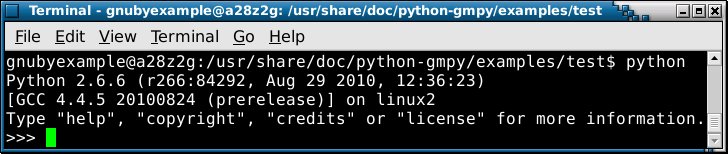
  • apt-get install python-gmpy
  • cd /usr/share/doc/python-gmpy/examples/test
  • python test_large.py
5 seconds for the desktop Amd 7850 which is in a year old Asus P2-M3A3200
25 seconds for the laptop, an Intel T5550 based Dell and is 2 years old
My other desktop came inbetween those two, just slightly beating the laptop.


The winning system is running Debian Squeeze 64 bit and Python 2.6.6:


I mentioned earlier about this being a quick but unscientific way of choosing a suitable machine for you mathematical task.

You will perhaps have a particular task in mind. If it is linear algebra based then you might want to run some sample tests using octave, or scilab, or sage.

Here is a useful link to benchmarks that include some linear algebra/matrix operations:

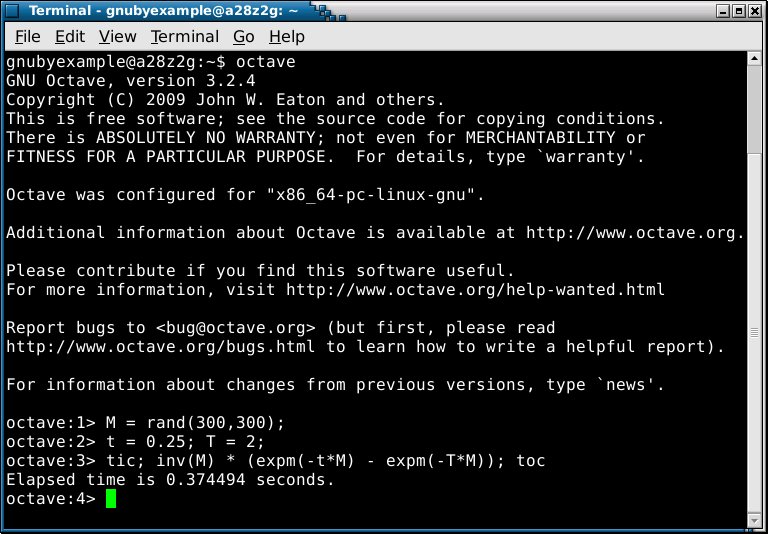
Whilst looking around for benchmark results, I came across this 2007 post, that includes a 300x300 matrix timing test, and here are my results:


(optional) more technical specs for the Asus:
  • Chipset is AMD 780G
  • Socket is AM2+
  • Onboard Graphics are Radeon HD 3200
  • Memory installed is PC2-6400 DDR2-800 

( The above is by no means cutting edge, but for a £200 desktop system, as the benchmark shows, results are not too shabby )

(optional) Matrix commands in text format if you would like to repeat that 300x300 test in your own program:

M = rand(300,300);
t=0.25; T=2;
tic; inv(M) * (expm(-t*M) - expm(-T*M)); toc;

( I hope I made it clear from the link earlier that those commands appeared on a forum at wilmott.com
In particular blondie and spacemonkey posters used those commands for timing tests )

( The install commands such as apt-get which I have used to install gmpy are specific to my platform GNU/Linux. I am unable to provide help with other platforms, and suggest you might want to find a more suitable howto, that gives useful benchmarks including an install guide for your platform. )

Wednesday, September 15, 2010

sage 'open source mathematics' - some compilation experience

sage (or sagemath) is a unifying front-end to many computerised algebra and mathematical programs.
Previously I have used sage on Ubuntu Karmic and loved it.

Just now there is no official Debian or Ubuntu package for sage, and so installing it on my new system (Debian Squeeze) gave me a choice:
  1. Install the prebuilt binary package that sage themselves provide
  2. Download the source and issue 'make' on my own machine.
There is little advantage to building from source (option 2), unless you will be running mathematical procedures that run over several nights.

In particular if you are new to sage then the prebuilt binary packages are the 'no hassle' way of getting up and running.

If you just want to see what sage is about, then the live cd, is an excellent way to try things out (no change to your system at all)


Compiling and having sage 'self check':

Summary: make test

Note: I work on GNU/Linux and so my instructions are particular to that platform. Seek out the install guides at sagemath.org if you want help with another platform.

Download the latest .tar file from a mirror listed here.
( My .tar was around 300MB and I checked its md5sum matched against the site )

Untar into /usr/local/ or /opt/local/ or your home directory, as you prefer
( I will use /opt/local for this article )

Have a quick look at the readme file at /opt/local/sage-4.5.3/README.txt

Follow the install guide at sagemath.org in conjunction with this article.

I mentioned about getting sage to 'self check', and what I meant by that, was running the inbuilt mathematical tests that come with sage.

Glancing at README.txt you might be thinking of setting SAGE_CHECK="yes", however this is a different 'self check'*

( *Sage is made up of a number of .spkg files and SAGE_CHECK="yes" will initiate integrity checks on those .spkg files and checks for compatibility with your system )

Running make test initiates a two stage process:
  1. The build
  2. mathematical test suite
The test suite (step 2) took a couple of hours on a 2.8 ghz machine running Debian Squeeze 64 bit.


When you are all done then you might want to issue the following command:
chown -R someuser:root /opt/local/sage-4.5.3/

( replace someuser with the the username you normally log in with )

*** End of main article. ***
( The next section is for those interested in lower level details of sagemath source and .spkg testing in particular )

Bundling python within an application and compatibility:

Sage does not use Python that already existed on your system, and instead, bundles Python 2.6.4 to support all sage applications.

This is a perfectly valid approach* but does freeze in time, that bundled Python, against a moving target (your system and upgrades)

( *as a Debian user I would really like a version of sage that integrates more fully with optimised libraries debian itself took the trouble to install. This is not currently the case and I understand some of the why and why not involved. )

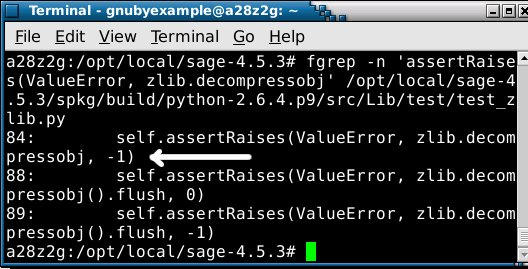
In particular Python 2.6.4 bundled in sage 4.5.3 is probably missing a patch to the file test_zlib.py

Unpatched (as supplied by sagemath.org) my output using SAGE_CHECK="yes" was:
test test_zlib failed -- Traceback (most recent call last):
  File "/opt/local/sage-4.5.3/spkg/build/python-2.6.4.p9/src/Lib/test/test_zlib.py", line 84, in test_baddecompressobj
    self.assertRaises(ValueError, zlib.decompressobj, 0)
AssertionError: ValueError not raised

322 tests OK.
3 tests failed:
    test_distutils test_httpservers test_zlib

...but then applying the patch with a manual edit to the file test_zlib.py


...sees test_zlib outcome being different as shown:

test_zlib
323 tests OK.
2 tests failed:
    test_distutils test_httpservers

When the next version of sage (4.6) is officially released, hopefully it will include Python 2.6.5 or newer, so as to have that patch already applied.

Links and reference:

Wednesday, March 24, 2010

Real World Probability - failure rates and social networking

People sometimes have difficulty understanding the relevance of Mathematics in today's world.

One way of overcoming this is to take the time to appreciate (and talk about) real world examples.

This is only a short post just to give you a pointer to something interesting related to Facebook.com - something lots of people just leaving the education system will have had exposure to.

Social networking runs atop of massive datastores, these datastores are at the leading edge of current computing theory, with regard to latency and failure rates. Mathematics is at the heart of understanding the probability of failure.

Facebook is making use of a datastore named Cassandra and the Gossip protocol - what these are is not really so important (from a Mathematics perspective). What is interesting Mathematically is the probability theory involved in the operation of the Failure Detector.

There is a great presentation by Avinash Lakshman and Prashant Malik, which you should be able to locate by websearching using this link.

The mathematics begins around page 17 of 24 titled "Properties of the Failure Detector"

( You don't have to really understand the content - just skipread the slides and ignore much of the jargon. )

The key point of this article, is hopefully, that Mathematics is being put to use today so that you can get your Facebook quicker :)

(Note: Twitter and Buzz are my social networking choices, but that does not stop me lauding Facebook and their use of Mathematics to achieve their business goals)

Tuesday, November 10, 2009

Mersenne Numbers - short sage example

I have used Sagemath and Pari/GP in the past and have found them both very capable Mathematics tools.

Pari/GP has been around a bit longer*, and has many recorded sample code snippets in The On-Line Encyclopaedia of Integer Sequences which AT&T kindly host.

(*Pari/GP has been GPL licensed for free use and modification for the last 15 years or more)

Sage is a bit different than a dedicated number theory program, and could perhaps be described in several ways:
  • A unifying front-end to many computerised algebra and mathematical programs
  • A means of accessing lots of computerised systems using a common language (python)
  • A front-end to Pari/GP (if you are doing Number Theory)
Anyway back to the maths...

See example output from below Sage script on sagemath cloud.

# Most Positive Integers of the form -1+2**n are Composite rather than Prime
#
# There is no significance to the range of numbers 7 through 37
# I selected that range so the primality test is_prime would not
# take too long.
#
# There are more than Mersenne Composites and Mersenne Primes generated by this
# loop. For example 8 gives -1+2**8 = 255 which is not a Mersenne Composite
# nor a Mersenne Prime.
#
# Expect many Falses and just a few Trues (Mersenne Primes) in the output.
#
for n in range(7,37):
mn=-1+2**n
print mn, is_prime(mn)
# True and False are intended to indicate if the number is Prime
# False indicates that the preceding number is a Composite

There is very little involved, and I could have written just the 3 lines and left it uncommented, however a few explanatory comments will hopefully illustrates things a bit better.

What inspired this example was some tabulation I did a while back; an extract is pasted below (click to enlarge):


If you have worked with Mersenne numbers before, then you will have spotted, I hope, that the example loop I used in sage is a bit too simple.

What makes a Mersenne number of any kind, is a prime power of two rather than just any old power of 2. So to be strictly useful, the sage example should only iterate through prime numbers for n, rather than all numbers in the range 7..37.

The great thing about an online version of sage is that anybody can register for an account and submit an example. Please feel free to alter the example I have given here to make it work better as just described, and try sage notebook yourself.
( Easy to take a copy of what I have done and paste it into your own notebook. )

Several universities already host sage online (convenient student access), although it is simple to install on any Ubuntu laptop if you want your own installation rather than relying on the Internet.

Downloads of Sage mathematics for other systems are available here.

Having read this article, and in particular my words on how to improve the example I gave, you might want to come up with your own enhancement to the opening line of Wikipedia's entry (2009 current):
In mathematics, a Mersenne number is a positive integer that is one less than a power of two

Finally a tip for any Pari/GP users who try Sage mathematics:
You may be using is_prime() rather than writing in pari isprime()
and here is quick extract to confirm what you are getting:
sage.rings.arith.is_prime(n, flag=0)
Returns True if prime, and False otherwise. The result is proven correct - this is NOT a pseudo-primality test!.

Friday, May 1, 2009

python and divisor summing

There are lots of areas of number theory concerned with exact divisors of integers - perfect numbers, amicable numbers, sociable numbers and much more.

A good place to begin understanding the behaviour of the divisor sum functions
[ divsum() in maxima, sigma() in pari/gp ] is to consider the integers 1 to 100.

A simple python program to show you what happens for
those integers is given below.

#!/usr/bin/python
## Aliquot sequence demonstrator
## This program was written as a very simple demonstrator of what
## happens for numbers in the range 1 through 100 as, for each,
## you sum the 'proper' divisors and repeat.
## In order to make viewing on a terminal output practical the
## routines work in batches of 10 (or 20) at a time as
## required.
## A crude approach to knowing when to stop printing relies in
## part on a list of known terminators.
## A more general program would instead maybe look at how many
## repetitions of the same value had occurred instead. Try that
## once you have decided how many repetitions you think are
## appropriate.
## Further reading on aliquot sequences might be had by searching:
##  The Lehmer Five are the first unterminated aliquot sequences
##
## (c) 2009 Gary Wright
##
##This program is free software: you can redistribute it and/or modify
##it under the terms of the GNU General Public License as published by
##the Free Software Foundation, either version 3 of the License, or
##(at your option) any later version.
##
##This program is distributed in the hope that it will be useful,
##but WITHOUT ANY WARRANTY; without even the implied warranty of
##MERCHANTABILITY or FITNESS FOR A PARTICULAR PURPOSE.  See the
##GNU General Public License for more details.
##
##You should have received a copy of the GNU General Public License
##along with this program.  If not, see http://www.gnu.org/licenses/
##
## http://www.wrightsolutions.co.uk/guide/code
## V1.0 20090501GW
##
#import divsum_out as ds
#ds.divsum_out20(range(20,40))# Readable when do divsum_out20(range(20)) ...
#...but not much higher
#ds.divsum_out10(0);divsum_out10(10)# More reabable and presentation suitable

known_terminators = ( 0, 6, 28 )     # tuple as immutable data

def divsum_out(n1):
print "%s%3i%s" % ('#',n1,'#')   # For first entries/line use
                                 # bang rather than pipe (|)
                                 # so easy to distinguish the first entries
                                 # which are just the numbers themselves.
#printf( ,'|',n1,'|')
while(n1 not in known_terminators):
    n1 = divsum(n1)
    print "%s%3i%s" % ('|',n1,'|')
return

def divsum(n):
# Sum all those values in the range 1..n-1 that are aliquot divisors of n
return sum(i for i in range(1, n-1) if n % i == 0)

def divsum_out20(nlist):
""" Run through divisor sums for 20 integers given as an input list
"""
delim = '#'
still_running_counter = 20
while(still_running_counter > 0):
    line = ''
    for i in nlist:
        line += (len(line) == 0)*delim
        line += str(i).rjust(3)+delim
    print line
    still_running_counter = sum(i for i in nlist if i not in known_terminators)
    delim = '|'
    nlist = map(divsum, nlist)
return

def divsum_out10(sval=0):
""" Run through divisor sums for 10 integers beginning with the supplied integer sval
sval is an abbreviation for Start value and defaults to 0.
You might try 10 or 20.
"""
delim = '#'
nlist = range(sval,sval+10)
still_running_counter = 10
while(still_running_counter > 0):
    line = ''
    for i in nlist:
        line += (len(line) == 0)*delim
        line += str(i).rjust(3)+delim
    print line
    still_running_counter = sum(i for i in nlist if i not in known_terminators)
    delim = '|'
    nlist = map(divsum, nlist)
return


I ran this as follows:
python -i divsum_out.py
>>> divsum_out10(0)

If you are new to python then you should refrain from typing the '>>>' which I included just to indicate (as python does) that you are then within an interactive python shell.

If you prefer to do your maths in maple then you might websearch for aliquotparts and aliquotsum functions.

Note: The web url and mail address given in the code are yet to be operational and will be usable when the server setup is complete in late summer 2009. I include them for future reference only.