Monday, February 8, 2016

primes and quadratic involving deduction of 2

Take a prime p and double it then deduct 5 to obtain 2p5

candidate = -2+p*2p5

Is candidate prime?

Example p=53 so 2p5 =101

5351=-2+53*101
5351 is prime

Next try p=47 so 2p5 = 89

4181=-2+47*89
4181=37*113


Next try p=59 so 2p5 = 113

6665=-2+59*113
6665=5*31*43

Next try p=61 so 2p5 = 117

7135=-2+61*117
7135=5*1427


Next try 67 so 2p5 = 129

8641 is prime

Now algebraically we might say -2+p*(2p-5) which is rewritten 2p^2-5p-2

Next try 71 so 2p5 = 137

9725=-2+71*137
9725=5*5*389


Next try 73 so 2p5 = 141

10291=-2+73*141
10291=41*251

Next try 79 so 2p5 = 153

12085=-2+79*153
12085=5*2417

Next try 83 so 2p5 = 161

13361=-2+83*161
13361=31*431

Next try 89 so 2p5 = 173

15395=-2+89*173
15395=5*3079


Next try 97 so 2p5 = 189

18331=-2+97*189
18331=23*797

Next try 101 so 2p5 = 197

=-2+101*197
=5*23*173


Next try 103 so 2p5 = 201

20701=-2+103*201
20701=127*163 is composite


Next try 107 so 2p5 = 209

22361=-2+107*209
22361=59*379 is composite


Next try 109 so 2p5 = 213

23215=-2+109*213
23215=5*4643 is 5 divisible


Next try 113 so 2p5 = 221

24971=-2+113*221
24971 is prime


Answer will be divisible by 5 when -2+2p^2 is divisible by 5
( or written another way answer cannot be divisible by 5 when -2+2p^2 is not divisible by 5 )


Now we redo the above example but with slightly different assignment for p

Set the prime 113 then deduct a 100 and use that figure as p

13 is prime
p=13

113=p+10^2

221 = p*(p+4)

-2+(p+(2*5)^2)*p*(p+4)


prime 24971==-2+113*221            ( 221 is 13*17 )


p=17

 -2+(p+(2*5)^2)*p*(p+4)

41767=-2+117*17*21
41767=11*3797


p=19

-2+(p+(2*5)^2)*p*(p+4)
51201=-2+(7*17)*(19*23)
51201=149*349


p=1053 so p+100 is 1053
p2=1053

prime 1283313211==-2+1153*(1053*1057)

( 1283313213==(3^4)*7*13*151*1153 )


Now let us vary things slightly by defining p2=p+100 and having our answer derived as -2+(p2^2)*(p2+4)

p=953 which is prime and then p+100 is 1053
p2=1053

prime 1172011111==-2+1053*(1053*1057)

( 1172011113==(3^8)*7*(13^2)*151 )


Tuesday, September 10, 2013

sagemath terminal colours - green > blue

Sagemath includes an embedded version of ipython and any changes you make to terminal colours need to happen in ipython_config.py in the correct place.

After doing a sage install there is a directory on my computer at location:
~/.sage/ipython-0.12/

The goal of this short set of hints is to assist you in creating a suitable profile_sage/ipython_config.py file.

That file should look like this:

# Configuration file for ipython.

c = get_config()

# Set the color scheme (NoColor, Linux, or LightBG).                                                                    
c.TerminalInteractiveShell.colors = 'Linux'

What that will achieve is to make your prompt green instead of blue.
The default (blue) seems a little bright on the eyes, so by setting colors = 'Linux' you get the less garish green prompt instead.

You can just run ahead and use geany or another editor to create ipython_config.py with content detailed above.

If you prefer to look at what iPython itself generates then you might wish to know of these two commands:
  • ipython profile list
  • ipython profile create justcreatedbyme
However be aware that you want to be running the embedded ipython version when doing 'profile create' in order to be sure a a fully compatible profile is created.
( Manual copy / rename things to get file to proper location of
profile_sage/ipython_config.py )

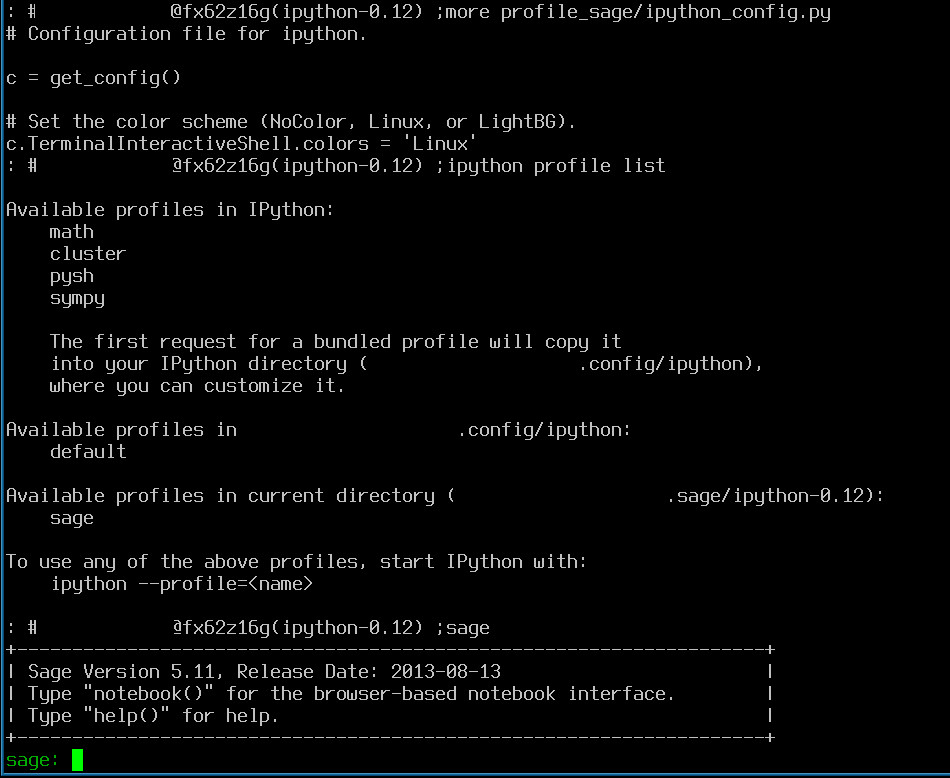
An example of the output from profile list is shown below:

List of profiles available to iPython

Thursday, June 27, 2013

Power of negative number - pari gp

Do use parentheses () to wrap your negative where necessary.


Because exponentiation has priority over +/- you should wrap your -1 in parentheses (), or, if just squaring, use the sqr() function.

The priority of operators in Pari/GP is detailed in Section 2.4 of the User Guide and titled "2.4 GP Operators"

Sunday, January 20, 2013

number of digits function - sage - sagemath

If you work with Sage a lot, then these two points will help you remember how to get a digit count:
  • Sage uses Objects to represent mathematical constructs
  • Sage is written in Python
   two_to_ten=2^10
   a_to_power=11^two_to_ten
   len(str(a_to_power))

Answer: 1067

There are 1067 digits in the number formed when 11 is raised to 1024

Pari/GP and number of digits:


In Pari/GP the length() function can be used in a similar way to len() in Sage. In Pari try length(Str(11^1024))


You can still access Pari/GP directly through sage.

Try this in Sagemath:


   gp("length(Str(11^1024))")

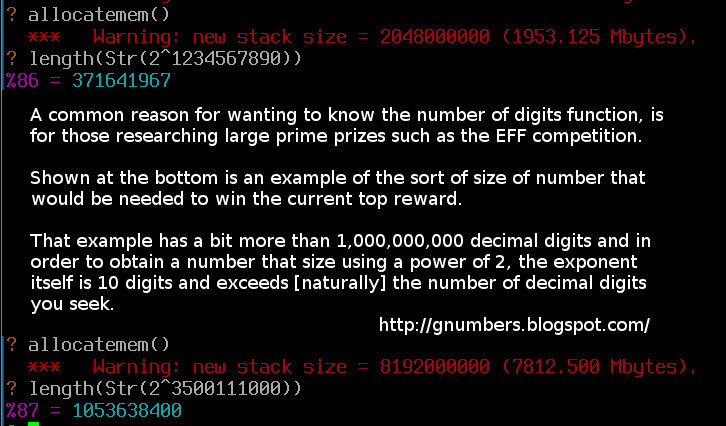
The very large - two examples using Pari:


( click on the image above for optimal font sizing )

Notes and further reading:

You can check the 11^1024 digit count yourself by following this wolfram alpha link:
    http://www.wolframalpha.com/input/?i=11%5E1024

Python note: Although sage allow you to use ^ to indicate raising to power, when writing in Python directly you should use the correct ** operator.
Pari/GP is designed particular for number theory, and does not have a real need to store mathematical constructs as api friendly Objects [by default] in the same way as Sage does.

Tuesday, May 1, 2012

ipython - Better Feedback for Beginners

Having worked with Python through Sage Mathematics, and directly through Emacs, I never really took the time to understand what IPython offers.


For beginners or Intermediates who want to try something to see if it adds to their productivity, IPython is worth a look.


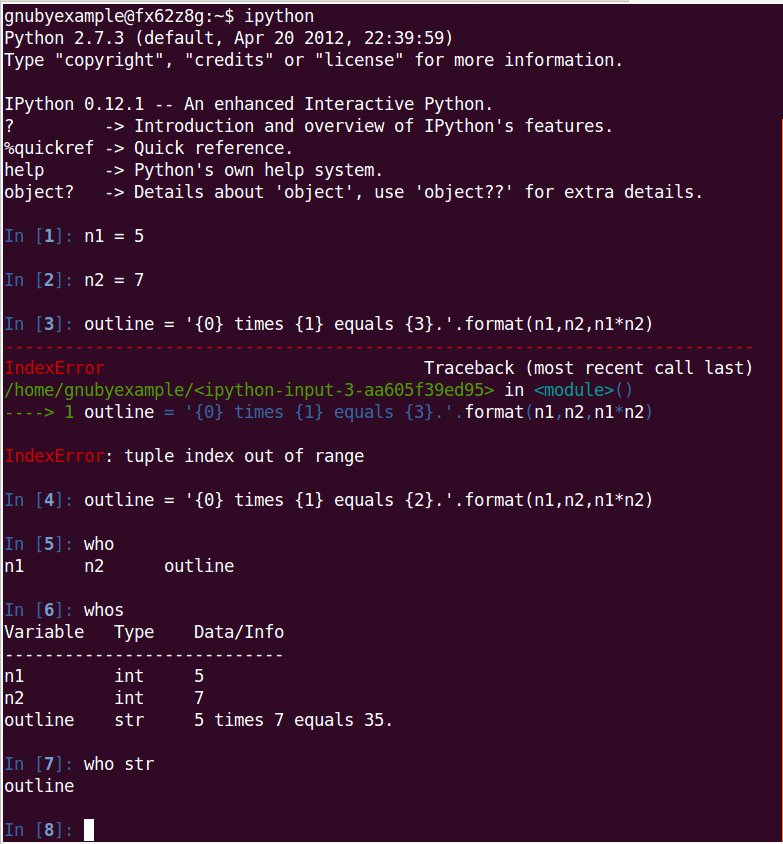
who and whos:

%who lists names of all objects, but %whos shows the list with type and contents summary.

Depending on your system IPython setup, you may be able to omit the % at the front and just type who and similar 


'run' and variable inspection:

The run command executes your python [script] and brings the variable into the interactive namespace.

There are many more features of IPython like tab completion, history, and logging.

Do take a look and see if it can add anything to your productivity in Python.

There is an interactive test site here if you want to get started now:

Sunday, November 20, 2011

Ex student? How much for £300 per week take home?

How much Salary does a graduate have to earn to take home £300 a week?

Answer: Around £27,000 per annum


Rough estimate - including Student Loans Company (slc):

Assuming a nice round 60% net (tax + NI is approx 40%), we see...

£300 x 52 gives £15,600

Divide by .6 to gross up that figure gives you the higher gross of £26,000

£15,600 / 0.6 = £26,000

£90 * 12 = £1,080 (annual slc repayment on £26,000)

Estimate: £27,080


But 40% for tax & NI is wrong? But £90 per month slc is wrong?

These figures are a bit rough and ready. Feel free to substitute your own percentages.

A spreadsheet to help with the monthly repayment to slc can be found here

Note: Spreadsheet is in Open Document format (.ods).
Download LibreOffice to edit or view locally

You can view it directly in Googledocs here


Below is a preview image:


The Tax and National Insurance rate estimates are local to the United Kingdom, please adjust as appropriate for your local situation.

UK Zero Percent Tax threshold in 2014:

From April 2014 the personal tax threshold (level below which no income tax is payable) is estimated at £10,000

What this means for somebody earning £27,000 is that 17,000 of their salary is taxed at entry level tax rate of 20%.
Making Annual income tax liability of £3,400 (Monthly £283.33)

The earlier statement "tax + NI is approx 40%" overstates things a little. Being an employee on that sort of salary means paying 12% National Insurance (NI).

Update the spreadsheet to reflect the current picture and get a more accurate estimate.

The £90 monthly payment to your Student Loan is still payable, and is not affected by changes in Tax or NI rates.

Saturday, November 5, 2011

Science - who should have a voice? is silence Scientific?

I am not anti-vax, I am not pro-vax, and I am no more comfortable with the ex actor becomes science voice, than I am with ex actor becomes president.

One thing that I would say, is that whilst I am no fan of Mr Celebritee, or Ms Ex Baywatch, it would also not be entirely wise, to smack down completely, all voices from outside the Scientific establishment.

It maybe in 15 or 20 years that Science (the community) has more of your faith, or less of your faith, but whatever, it might not be the same level as today.

If I could turn down the volume level on the non-science stuff/people then that would be great, but be careful of pursuing a policy of Science (establishment) or strict silence.

Here is an illustration:

Science - Non-science celeb
.       -  A
a       -  A
A       -  A
A       -  a
A       -  .

The final option above is the 'Scientific establishment only' viewpoint - where you might advocate nothing else having a voice.
This option is not what I would choose.
Neither would I choose the first or second lines above.

I have been on the receiving end of some difficult reading in the past.
Reading journalists using pseudo-science to build a following around a view, that serves corporate lobbyists, but also their own profile, is painful.

I do not have a total solution.

The Internet has created a great way of building a community around celebrity messages.
Sometimes those celebrities are not in it for the good of that community, and may even be part-funded by a company that stands to make a good profit, from debunking the current Scientific view in a particular area [ allegedly ]

One solution is to give all citizens at least some introductory experience in critique, and researching of funding/sponsorship.
In the UK we have school leavers well versed in Facebook likes and shares, but who have no idea how to critique or spot a 'sponsored' report.

The very fact that political lobbying is so successful in the West, is testament to how lacking, in even basic critique, some countries citizens really are.


Celebrity bloggers do science - Is this the return of Quackery?

Possibly.

However listening (entirely) to the Science establishment reaction to this, might see too strong a response.

I watched a TV programme in 2011 where the President of the Royal Society, Sir Paul Nurse talked about the state of Science, and the rise of the celebrity blogger.

I agreed with much of what was said in that programme, however [ going back to the critique :) ], there is a billion pound Science industry in the UK, and most of what was said is, what you might expect of somebody seen as a figurehead for the Science establishment.

One thing that I seem to recall was the message that Science is on trial because of recent events / debates.

In order to have a trial, you need a jury, even though that jury may include types who you personally cannot stand :)

The Science establishment cannot be it's own jury*. Perhaps our job might be to ensure that, where practical, we enhance (and share) our personal critique skills, and be aware of how to spot the quackery.

jury* here does not mean peer review. Peer review is very important and I respect that, however if an 'alternative view' is growing stronger because of celebrity bloggers, then perhaps it is unwise to ignore how the 'lay person' feels about Science. Just how are you going to address this Scientists?

To avoid any confusion: I am an advocate of peer review, and appreciate how important this is - recent example - the reexamination of the 'faster than speed of light' speculation of European Physicists in 2011 - stimulated by CERN / observations between Switzerland and Italy.

I am not a Physicist, and have no clue about relativity.
However as a lay person (in the area of Physics), it is helping my faith in that area of Science, when I see such a 'peer review' process in action.

However the Scientific establishment is not infallible (see link below)
Science is not the only voice I want to listen to.
My (personal) choice is to listen closely when Scientists speak, but also, not to assign zero weight to other voices.

Whilst I appreciate the importance of established Scientific Journals, I also appreciate the need for arxiv


Notes and Further Reading:

Extract from Heaviside (from link below):
Heaviside was not interested in rigour...
Whist rigour and proof are very important, there are very occasionally folks, who despite resisting rigour and process, manage to discover and apply something magnificent.
( Just to be crystal clear here I am thinking about Heaviside, and not any celebrity bloggers that I have read to date )

Heaviside did eventually get the recognition that he deserved, however the people who he did not 'get on with' entirely, managed to delay that recognition by several years.

The Scientific Establishment is a people system, and just like any people system (or computer system), is likely chock full of imperfections.

However my personal view, it that the Scientific Establishment (currently) does a pretty good job, so I will keep listening.

There have been at least two major Science debates in the last decade, where public opinion has really entered into the debate. In neither case, have I personally seen anything, that had me thinking, on those particular issues, that Science was wrong.
However I do not rule out in the future, the possibility, that I might find myself disagreeing with Science on a particular issue either.

For me it is an issue by issue thing. On individual topics, I try to critique where I can.

Want to help make Science more open? Read the manifesto and consider endorsing.

Note: I have no personal affiliation to Nick Barnes or that manifesto, read and critique what is said for yourself.